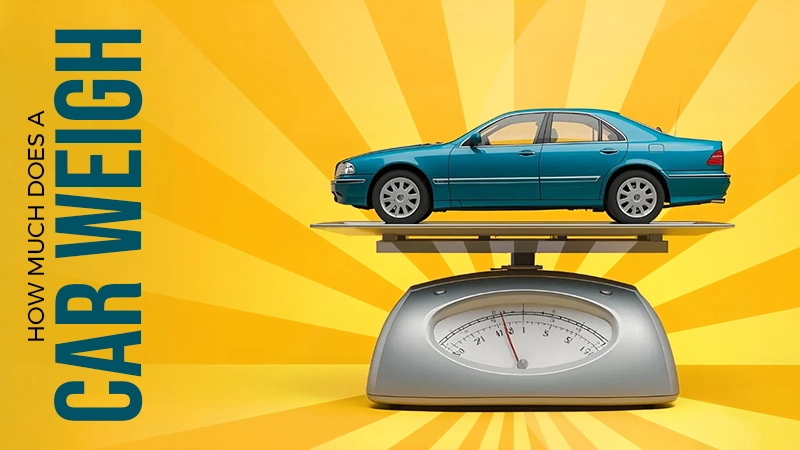
While the average weight of the car has evidently increased over the past few years, its impact on the fuel economy, safety, and performance has been significant. Since heavier vehicles have a lower fatality rate during accidents, the compact vehicles tend to deliver optimal fuel efficiency.
However, the average car weighs between 2400 lbs and 10,000 lbs, prompting owners to inquire how much does a car weigh to analyze safety ratings and fuel efficiency of their vehicle.
Following this, to understand how much does your car weigh, read our detailed article covering the average car weight based on its type and GVWR category.
How Much Does a Car Weigh on Average?
How much does a car weigh depends significantly on its category, along with the model and the materials used in its construction.
However, how much does the average car weigh is based on its type and usually lies between 2,500 and 6,000 pounds. Subsequently, the average weight of commercial vehicles ranges between 5,000 and 80,000 pounds.
Furthermore, explore our detailed list below to analyze how much a car would weigh on average based on its type:
Average Weight of a Car Based on Its Type
The average car weighs between 2,500 and 4,500 pounds, whereas trucks and heavy-duty vehicles weigh between 3,500 and 6,000 pounds. However, to discover how much does an average car weight, refer to the detailed table below:
| Regulatory Class | GVWR Category | Type of Vehicle | Average Car Weight (lbs) | Average Car Weight (kg) |
| Car | Light Duty | Small cars/hatchbacks | 2400 – 2600 | 1080 -1180 |
| Car | Light Duty | Mid-sized sedans/wagons | 3200 – 3800 | 1450 – 1725 |
| Car | Light Duty | Compact SUV | 3300 – 4000 | 1495 – 1815 |
| Truck | Light Duty | Full-sized SUV | 5500 – 7000 | 2495 – 3175 |
| Truck | Light Duty | Minivan/ Van | 4500 – 5200 | 2040 – 2360 |
| Truck | Light Duty | Pickup | 5000 – 6000 | 2260 – 2721 |
| Truck | Heavy Duty | Cargo Trucks | 60,000 – 80,000 | 27,215 – 36,288 |
Average Weight of Commercial Vehicles
The average weight of commercial vehicles often ranges between 5,000 and 80,000 pounds and tends to be higher than passenger cars, since they are built to carry 7-15 passengers based on their category.
| Type of Vehicle | GVWR Category | Average Car Weight (lbs) | Average Car Weight (kg) |
| Pickup Truck | Light Duty | 5000 – 6000 | 2260 – 2721 |
| Delivery/ Courier Van | Medium Duty | 10,000 – 12,000 | 4545 – 5445 |
| Ambulance | Medium Duty | 9000 – 10,000 | 4083 – 4545 |
| School Bus/ Passenger Bus | Medium Duty | 18,000 – 30,000 | 8165 – 13,608 |
| Fire Truck | Heavy Duty | 38,000 – 60,000 | 17,237 – 27,215 |
| Carrier Trucks/ Tractor-trailer | Heavy Duty | 60,000 – 80,000 | 27,215 – 36,288 |
Also Read: Best Car for Teens in 2025: Top Cars for Every Budget, Specifications, and Some Useful Tips
What are the Different Types of Car Weight and How Is It Determined?
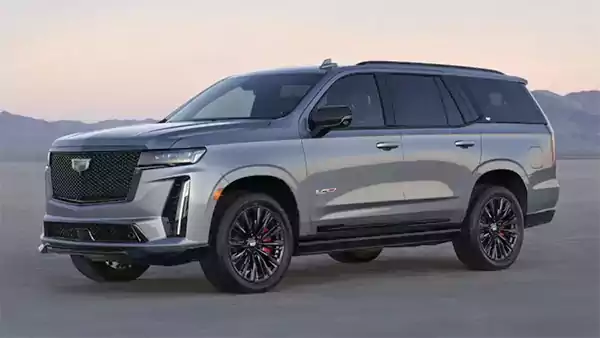
The weight of the car is determined as kerb weight, dry weight, GVW, GVWR, GCWR, payload, or GAWR. It is essential to analyze different types of car weights to determine their payload capacity and your car’s gross weight without any passengers. Let’s explore these categories in detail below:
- Kerb Weight: The kerb weight of a vehicle is determined when the vehicle is in a stationary state without the driver, passengers, tools, and freight. Following this, the kerb weight also includes the essential automotive fluids and mechanical components.
For instance, the kerb weight of the 2025 Ford Expedition ranges between 5,400 lbs and 5,670 lbs for 4×2 and 4×4 models.
- Dry Weight: The dry weight of a car is basically the kerb weight, excluding the essential automotive fluids such as fuel, oil, or coolant. Furthermore, it also doesn’t include the mass of passengers, the driver, or cargo.
For example, the dry weight of the Toyota Tacoma 2025 ranges from 4,330 lbs to 5,100 lbs.
- Gross Vehicle Weight (GVW): This is the total mass of the vehicle with the weight of all the necessary automotive fluids, along with passengers, driver, equipment, and cargo. Subsequently, it is the vehicle’s full load operating weight that the manufacturers specify.
To illustrate, the 2024 BMW X3 has a gross vehicle weight ranging from 5,350 lbs to 5,512 lbs.
- Gross Vehicle Weight Rating (GVWR): The gross vehicle weight rating is the normal vehicle weight, including the gross car weight with all the passengers, cargo, and accessories. Furthermore, it assists the drivers in analyzing the maximum load-bearing capacity of the vehicle.
For instance, the gross vehicle weight rating of the 2024 Ford Explorer is 6,160 lbs.
- Payload: Payload is the car gross weight, including driver, passengers, and freight, along with the towed vehicle. It is the section of the vehicle’s cargo, including passengers, that determines the payload capacity, excluding the vehicle’s engine, transmission, fluids, and fuel.
To illustrate, the payload capacity of its Toyota Innova Crysta is 1,245 lbs.
- Gross Combination Weight Rating (GCWR): It is the maximum permissible weight limit for a vehicle, including the weight of the vehicle with all its passengers, accessories, equipment, cargo, and its trailer combined. This also helps the owner determine the total weight their vehicle can withstand, along with its trailer.
To understand further, take the example of the 2025 Ford Bronco Sport, which has a gross combination weight rating of 4,630 lbs.
- Gross Axle Weight Rating (GAWR): The GAWR determines the maximum load-bearing capacity of your car’s axle when it is fully operational. This also assists the owners in understanding the towing capacity, as every car axle is equipped with a rating.
Also Read: 10 Best Car Air Fresheners of 2025: Top Picks for a Fresh Ride
Why Is It Essential to Determine the Weight of the Car?

Understanding how much do cars weigh is a crucial aspect of discovering the levels of safety and performance, their towing capacity, and scheduled maintenance, along with the fuel efficiency your car will deliver.
- Vehicle Performance: To discover your car’s performance potential, it is crucial to analyze the weight of the car, as larger vehicles require a robust engine to accommodate their heavy weight and produce optimal performance and acceleration.
- Fuel Efficiency: To calculate fuel economy accurately, you must first analyze how much does a car weigh, as a car’s weight has a significant impact on the fuel required to cover a certain distance. Furthermore, every 100 pounds that is removed from the car’s gross weight helps in achieving 1-2% better fuel economy.
- Car Safety: While lighter vehicles deliver better fuel economy, they are also more fatal in accidents as compared to larger vehicles, as heavier vehicles with more weight endure less damage, and fewer passengers are prone to fatal injuries.
Subsequently, full-size SUVs with bigger front ends have better safety features than compact cars, and they will sustain a lower fatality rate during accidents.
- Towing Capacity and Gross Vehicle Weight Rating: It is crucial to analyze your vehicle’s weight to discover its towing and payload capacity, which is the total cargo and passenger weight your car can carry without any hassle.
Following this, learn about gross vehicle weight rating, as it is the maximum load-bearing potential of your car, and you should avoid going beyond it for optimal safety.
- Scheduled Maintenance: If you prefer to perform the regular maintenance yourself, then you must calculate your car’s weight, as the car tools have a weight limit, and picking them accurately requires the knowledge of correct measurements.
Furthermore, brakes and tires have a shorter lifespan on heavier cars as compared to compact cars and hatchbacks.
Also Read: Top 10 Best Car Waxes in 2025
How to Analyze the Exact Weight of the Car?
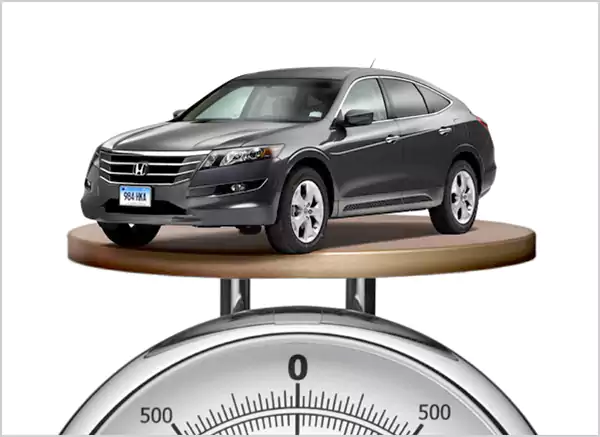
If you wish to analyze the exact weight of your car, you can refer to the owner’s manual, driver’s side door sticker, car scale, or visit reliable automobile websites.
- Owner’s Manual: The easiest method to know about your car’s gross weight is to refer to your owner’s manual, which has the necessary information about your car’s specs, engine, transmission, and weight.
- Driver’s Side Door or Registration Documents: You can search for a door sticker on the driver’s side door, which will have the Vehicle Identification Number (VIN) along with the essential details of the car’s weight and gross vehicle weight rating. Furthermore, you can also check the registration documents that must have your car’s kerb unladen weight.
- Reliable Automobile Websites: Another easy yet effective way is to refer to any reliable automobile websites, such as Advisor Wheels, to explore the detailed specs, including kerb weight, payload capacity, and gross vehicle weight rating.
- Connect with the Manufacturer: You can also call your car’s manufacturer or visit the authorized website with the make and model details to learn the exact kerb weight or gross weight of your car.
- Car Scale or Public Weighbridge: Using a car scale or driving to a public weighbridge is a hectic yet effective approach to learn about the exact weight of a typical car. Furthermore, you can find a certified scale at service centers, truck stops, and inspection hubs.
Also Read: Ford Explorer Hybrid: Long-Haul Muscle Marries Hybrid Efficiency (Overview, Specs, Price)
Wrapping Up
Analyzing how much does a car weigh on average can assist you in determining the fuel efficiency, repair and insurance costs, and safety benchmarks.
Subsequently, a car’s weight is among the primary factors you should consider while purchasing a new car, as heavier vehicles sustain lower collision damage and offer better stability. However, compact SUVs, hatchbacks, and sedans deliver better cost savings on fuel consumption and repair costs.
FAQs
1. How much would a car usually weigh in tons?
Ans: Cars usually weigh between 0.8 and 2.5 tons based on their type and model, as compact cars range between 0.8 and 1.2 tons, while full-sized SUVs can even weigh over 2.5 tons.
2. Do Teslas weigh more than normal cars?
Ans: Yes, Teslas typically weigh more than normal SUV or sedan cars, as their average car weighs between 3977 lbs and 4200 lbs for the Tesla Model 3 and Tesla Model 3 Performance AWD.
3. What cars weigh 5000 pounds?
Ans: Full-sized SUVs and minivans/vans usually weigh over 5000 lbs, such as the 2025 Ford Expedition, which weighs between 5,400 lbs and 5,670 lbs.
4. What is the heaviest new car?
Ans: GMC Hummer EV, BMW X7, and Ford F-450 Super Duty Crew Cab are among the heaviest cars in 2025, as they weigh approximately 9,600 lbs, 7,000 lbs, and 8,600 lbs, respectively.