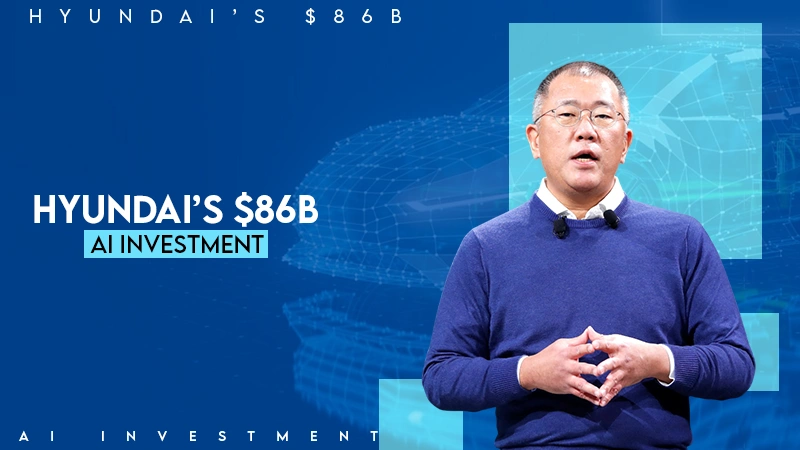
Over five years from 2026 to 2030, Hyundai Motor Group has unveiled a historic investment plan of ₩125.2 trillion (about US$86.5 billion) into its local business. This statement comes after the conclusion of a U.S.-South Korea trade deal that lowers U.S. import taxes on Korean cars from 25% to 15%. Hyundai’s commitment is on a scale that is a dramatic increase from its recent domestic spending, between 2021 and 2025, Hyundai and its affiliate Kia invested 89.1 trillion won.
Hyundai’s leadership positioned the expenditure as a strategic answer to trade-policy demands and as a reiteration of its dedication to South Korea.
Hyundai Chairman Euisun Chung admitted in a high-level meeting with President Lee Jae-Myung that although the lower U.S. tariff might reduce expenses, it also raises questions about declining domestic manufacturing.
Hyundai wants to diversify export markets, increase production from its Korean facilities, and more than double its exports from newly intended electric vehicle plants by 2030 to mitigate these hazards.
The company further promised assistance for local auto-parts suppliers unfairly hit by earlier U.S. tariff measures, while also referencing its broader initiative, ‘Hyundai’s $5.4 Billion War Chest: Targeting 15% Market Share by 2030,’ which underscores its long-term global expansion strategy.”
Hyundai has divided its investment across various main priorities. Artificial intelligence and companies focused on the future will receive 50.5 trillion won, or almost US$35 billion. Particularly in cutting-edge mobility, robotics, and EV technology, research and development is allotted 48.4 trillion. Optimizing manufacturing lines, modernizing infrastructure, and constructing a new headquarters tower will cost 36.2 trillion.
Hyundai’s decision to anchor this large fund at home shows faith in South Korea’s long-term position in the world auto market, even as it negotiates changing trade winds.
Parallel investments soothe local worries about the business’s inclination to give foreign initiatives precedence in view of enhanced U.S. market access. For the administration, Hyundai’s promise affirms national economic objectives. It fits with Seoul’s overall efforts to keep high-value investment in Korea, notably in key sectors like artificial intelligence and green mobility.